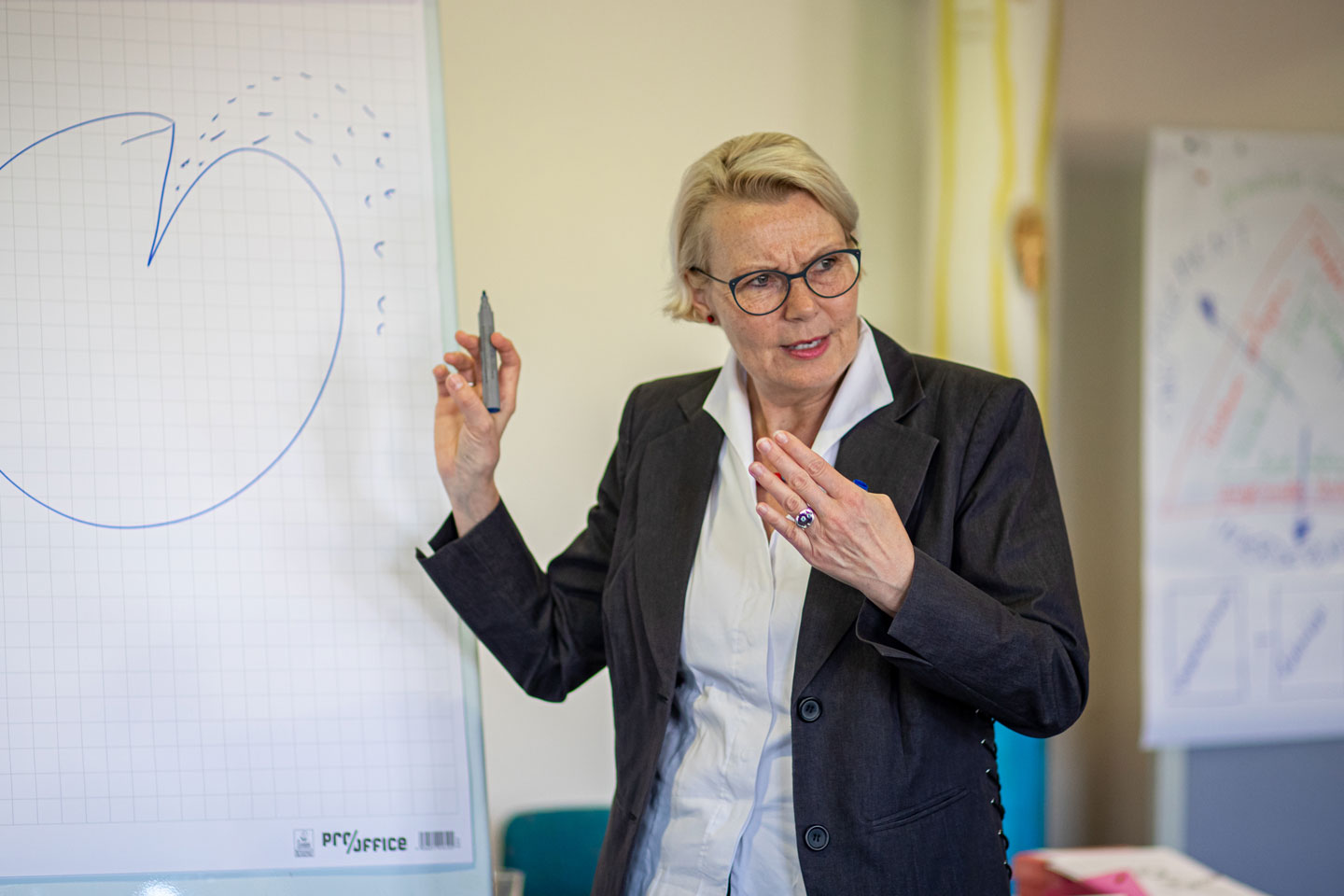
Leadership training in the healthcare sector – Rely on your own talents

German healthcare facilities will continue to face serious changes in 2025: The shortage of skilled labour has become even more acute. The demand for nursing staff is rising continuously. According to a forecast by the Federal Statistical Office, the demand for employed nursing staff is expected to rise by a third (+33%) from 1.62 million in 2019 to 2.15 million in 2049.
At the same time, technological developments such as digital documentation, AI-supported systems and telemedicine are increasingly changing everyday working life in care, medicine and administration. What’s more, the baby boomer generation is gradually retiring – and taking valuable experience with them. This affects medical staff as well as specialists and managers in nursing and administration.
One thing is clear: anyone who believes they can cover their future personnel requirements solely through external applications will hardly remain competitive in the long term. Competition for good staff has long been fierce. This makes it all the more important to focus on further training and personnel development in your own organisation – with professional management training that is tailored to the special requirements of the healthcare sector.
Targeted further training for nursing managers is particularly useful for personnel development in hospitals and for the further training of ward managers and nursing
management – practical, effective and future-orientated.
Why does leadership training make sense in the healthcare sector in particular?
“Because clear communication is a matter of luck, especially in German hospitals,” says Prof. Dr. Renate Tewes, founder and owner of Crown Coaching.
Studying medicine, nursing or administration imparts specialised knowledge – but hardly any leadership skills. There is generally no standardised training for prospective managers. People often take on management positions due to their professional qualifications, work experience or simply because she or he is the net-in-line. Targeted further training for managers in the healthcare sector is often lacking.
Yet this is a decisive factor for success: good leadership can be learnt – and it is decisive for motivation, cooperation and the quality of care.
Prof Dr Renate Tewes is a nursing scientist, qualified psychologist, certified business coach and professor of nursing science and nursing management at the Evangelische Hochschule Dresden. There, she has spent many years developing a part-time degree program that closely combines theory and practice:
“My goal has always been to qualify people in the nursing professions as managers through an accompanying degree program. A scientific background and practical experience in healthcare professions are closely linked in this degree program,” explains Dr. Tewes.
This combination of practical relevance and sound methodology is also at the heart of Crown Coaching International – founded in 2008. To this day, the consistently high number of bookings and positive feedback from participants show how great the demand for seminars for managers in the care sector is.
Leadership can be learned – with suitable modules for leadership training
Leadership development primarily means communication training – and this is precisely what is lacking in many German healthcare facilities. Numerous studies have shown this for years: Communication between professional groups is often inadequate, coordination is slow and many decisions are not clearly communicated.
The consequences are tangible:
- Patients do not feel that they are taken seriously.
- Managers find it difficult to motivate their team – and become dissatisfied themselves.
- Employees lose interest in their work or change their career direction.
What at first glance appears to be a purely emotional problem has economic consequences at second glance: falling patient numbers, high absenteeism due to overwork and increasing staff turnover at all levels jeopardise the quality – and the existence – of entire facilities in the long term.
Training for doctors, nurses and administrative staff
This is where Crown Coaching’s management training comes in – not with a raised index finger, but with a practical and motivating approach. The modules are geared towards real-life challenges in the healthcare sector and can be booked individually or as a series. The aim is to enable managers to fulfil their role confidently, effectively and with pleasure.
The modules include, among others:
- Leadership & Personality (basic module)
- Communication & collaboration
- Emotionally intelligent leadership
- Team development
- Stress management & job satisfaction
- Problem solving & conflict management
- Organisational development & change management
- Negotiation & meeting management
- Role clarification & professional development
Training for ward managers, nursing staff and employees in management positions
Crown Coaching’s management training is aimed specifically at various professional groups within the healthcare sector – with programs tailored to the respective requirements.
Our seminars speak in particular to:
- Ward managers who are new to their role or would like to deepen their leadership skills,
- experienced carers who have taken on or want to take on responsibility,
- as well as administrative managers, who often act as a link between management and practice.
A key objective is to strengthen the interaction between these professional groups. In technical terms: to promote interprofessional collaboration. After all, the better the communication between nursing, administration and medical services, the smoother everyday life runs – and the greater the satisfaction of patients and staff.
“Organisations that have encouraged this type of interaction through leadership training, among other things, are often in a better economic position after a short time. Job satisfaction also increases noticeably in each of these groups,” explains Prof Dr Renate Tewes
She does not see the tense situation in many facilities as the fault of individual managers:
“In most degree programs – whether medicine, nursing or administration – leadership skills are often barely taught. Anyone who recognises that targeted further training in nursing or a seminar for new managers is worthwhile has already taken the decisive step.”
This is precisely where professional management coaching in the healthcare sector comes in: It makes leadership reflectable, provides security in difficult situations – and at the same time offers space for exchange and collegial support. Crown Coaching generally trains management staff in the organisation itself and in with a limited group number so that all participants have time and space to develop.
Voices from participants
“Prof. Tewes, with your humour you really took me along with you, so that I could also look at unpleasant things in my leadership work. You can hold up a mirror so humorously that you really feel like changing your own (flawed) leadership behaviour. I will definitely tackle the topic I brought up and use the contact with the other participants to get the support I will need along the way. Thank you for your optimism and your genuine interest in my problem, er, I mean challenge of course (laughs).” (Head of Finance from NRW)
“I have to say that I have attended many leadership seminars. I have been in various management positions for 12 years and have been a managing director for 3 years. But this workshop was special. Close to practice, with a lot of knowledge transfer in a playful way and real practical solutions that can be implemented straight away. My expectations were definitely exceeded.” (Managing director of a clinic from Austria)
“Many thanks for the incredible number of practical case studies and solution tools! Solving problems has never been more fun. My toolbox, which I’ve packed for my day-to-day management work here, will soon be bursting at the seams and I’m really looking forward to putting the many things we’ve practiced here into practice.” (Nursing service manager from Bavaria)
Emotionally intelligent leadership – with clarity and attitude
Professional management training in the healthcare sector today involves more than just communication techniques. It is also about attitude, self-reflection and an understanding of one’s own mechanisms of action within the team. An important component of Crown Coaching is therefore the topic of “emotionally intelligent leadership”. If you want to be successful as a manager, you not only need technical knowledge, but also a high level of social and emotional competence.
These include:
- consciously dealing with emotions – your own and those of your employees,
- A clear view of your own values and their impact on the team,
- and the ability to create an atmosphere of psychological safety.
These so-called “soft skills” are no longer a “nice-to-have” – they decide whether teams work together or fall apart. Purpose-driven leadership, clear role clarification and trust at eye level are indispensable, especially in a complex environment such as a hospital or care facility.
Studies show: managers who promote emotional intelligence and psychological safety experience significantly less staff turnover and absence due to sickness in their teams. And: job satisfaction increases – at all levels.
Crown Coaching therefore offers targeted modules as part of its training program for managers in the healthcare sector to develop precisely these skills – individually, practically and sustainably.
All details on the content of the modules and the course schedule can be found here.
Would you like to find out more?
If you are thinking about developing leadership skills in your organisation, we will be happy to support you with a non-binding information session. Whether it’s a seminar for new managers, further training in care management or management coaching in the healthcare sector – we will advise you individually on the right formats, modules and options. It is best to briefly describe your request by e-mail. This will allow our team to prepare for the first talk. We will get back to you promptly.
Studies and sources on the topic:
Alexander Burstedde / Jurek Tiedemann, 2024: IW labour market forecast 2027
Prof. Dr Alexander Ghanem, 2024: Psychological safety: How medical teams work successfully

Prof Dr Renate Tewes is a renowned psychologist and nursing scientist with a passion for promoting healthy collaboration and strengthening emotional intelligence in leadership roles. As a coach, she supports her clients with customised strategies to master the challenges of modern health management.